

New Authority Inclusion Impact Tracker for Schools
Showing what has changed in your school
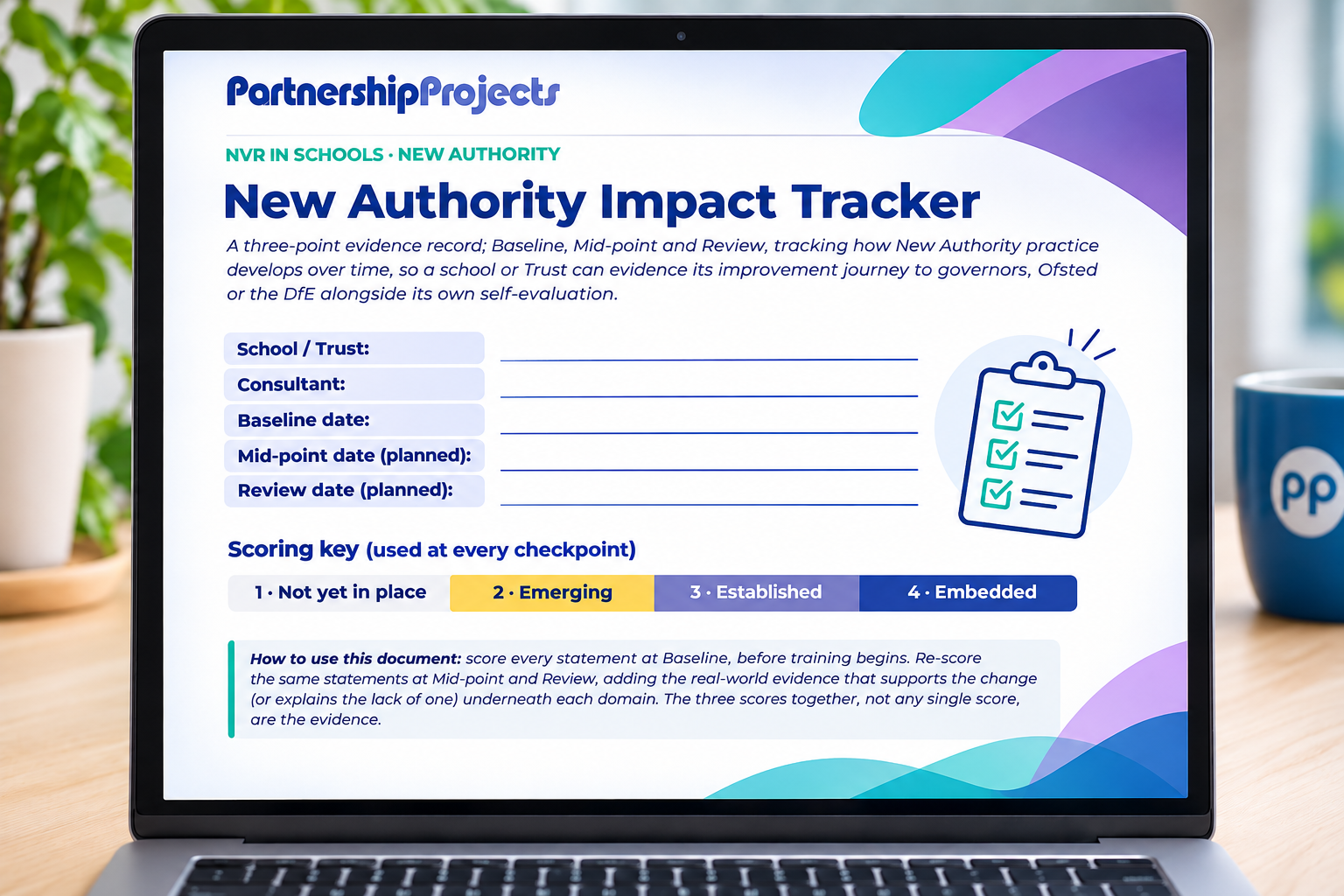
While your inclusion strategy sets out what you plan to do, the New Authority Impact Tracker helps you show what has changed. It is a record your school builds across the year, at Baseline, Mid-point and Review, giving you clear evidence for your strategy review, your self-evaluation and your governors, while adding as little as possible to anyone’s workload.
Why schools are using it now
We know schools are being asked for a great deal at the moment. These are the requirements we hear about most often:
- Inclusion strategies. Schools receiving the Inclusive Mainstream Fund must publish an inclusion strategy by 31 December 2026, and review it each year against its intended outcomes.
- Ofsted. Inclusion is graded as its own area, and inspectors look at whether your strategy can be seen in everyday practice.
- Suspension and exclusion guidance (July 2026). Schools need to show a graduated response before exclusion, and to review exclusion data for unequal impact.
- Belonging. The schools white paper expects every school to monitor pupils’ belonging and engagement by 2029.
What it covers
- Behaviour culture and policy: relational responses before sanctions, a shared approach to de-escalation, and regular review of exclusion data.
- Inclusion, SEND and SEMH practice: reasonable adjustments made by every adult, and alternative provision used as a last resort.
- Safeguarding culture: noticing when escalating behaviour may be a sign of unmet need.
- Staff wellbeing and retention: making sure no adult is left to manage escalation on their own.
- Whole-school consistency and leadership: induction, ongoing CPD and governor oversight of behaviour culture.
- Personal development and belonging: repair after incidents, and pupils who feel known by the adults around them.
How it works
- Baseline. We score the tracker’s 26 statements with your senior team and a staff focus group, and write a report setting out your priorities. This fits naturally with the barriers section of your inclusion strategy.
- Mid-point. We look again at the same statements and the evidence behind any change, and adjust the plan with you.
- Review. A final scoring and a written evidence summary that you can use in your self-evaluation, your strategy review and your report to governors.
What you receive
- Scores across six areas at three points in the year, with the evidence behind them
- A written report at each stage
- An evidence summary ready for your self-evaluation and inclusion strategy review
- A one-page summary for governors or trustees
- Links to the NVR in Schools training modules and toolkit for each area
Options
- Readiness Assessment: the Baseline on its own, online or on-site. From £1,200.
- Impact Tracker Year: Baseline, Mid-point and Review across the school year. From £3,750.
- Small-school clusters: three or four small primaries sharing joint sessions, each with their own report. From £2,350 per school for the full year.
- Trust package: every school in your trust on the same measure, priced by each school’s size, with 10% off for five or more schools and a trust-wide report.
Prices depend on the number of pupils on roll and exclude VAT. Special schools and alternative provision are priced at our standard rate, whatever their size. If you book an Impact Tracker Year within a term of a Readiness Assessment, we will take £500 off.
Built on Jackie Lindeck’s forthcoming book
The tracker sits alongside Jackie’s forthcoming book, Non-Violent Resistance in Schools: A New Authority Approach to Building Strength Through Presence (Pavilion Publishing, Spring 2027), and our CPD-accredited whole-school training. Each area of the tracker links to the training module and toolkit that develops it, so you can see where to focus, and then see whether it has made a difference.

Who are we?
PartnershipProjects has specialised in Non-Violent Resistance (NVR) training since 2006. We are award-winning and CPD-accredited, and we have trained more than 3,000 professionals in the last three years. Our school’s work is led by Jackie Lindeck, with consultants including Dr Tony Meehan, a former headteacher.
Frequently Asked Questions
Is this an inspection or a certification?
No. It is a record of how your practice develops over the year, written to support your own self-evaluation.
Can it be done online?
Yes. Readiness Assessments can be done online or on site, and online reports come back within two weeks.
Will it add to staff workload?
We have tried hard to make sure it does not. It draws on information you already keep, such as behaviour logs, exclusion data, staff absence and pupil voice, and we do the writing up.
We are only just starting out. Is it too early?
Not at all. A low Baseline is incredibly useful, because it gives you a clear starting point and makes progress much easier to see.
Can we use the Inclusive Mainstream Fund?
Professional development for inclusion, and building a safe and respectful culture, are both among the principles the fund supports. Each school decides how to spend its own allocation, so it is worth checking how the tracker fits with your strategy.
Do you work with special schools and alternative provision?
Yes. The statements apply across settings, and we adapt the conversation to your context.
Where to start
If you would like to see where your school is now, the free Inclusion Quick Check takes about five minutes. You are also very welcome to book a free 20-minute call to talk it through with us.