 My journey with Non-Violent Resistance (NVR) began during my final-year placement as a student social worker. At the time, my Practice Educator was an Advanced NVR Practitioner, and through our reflective conversations, I was introduced to the core strategies and philosophy of NVR—a concept entirely new to me, but one that instantly resonated on a deep level.
As someone who had lived through domestic violence and later experienced child-to-parent violence in my own home, our discussions often explored the emotional impact of witnessing domestic abuse, how trauma manifests in children’s behaviour, and my own feelings of helplessness as a parent. For years, I had searched for a way to understand and respond to the chaos around me. NVR felt like the missing piece I had been waiting for.
A Familiar Scene: Broken Doors, Unanswered Questions
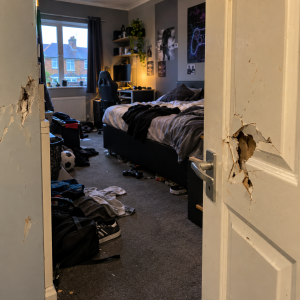
Holes in the doors, broken walls, smashed furniture—these were not just images of conflict; they were my everyday reality. When my child began displaying violent behaviour, professionals would often point to his aggression, but with little understanding of the underlying trauma. I was repeatedly offered parenting courses, which, while useful for some, never addressed the root cause in our situation. I believed then, and still do, that without understanding what’s beneath a child’s behaviour, no intervention will truly help a family.
This is what drew me to NVR. Unlike traditional approaches that isolate the child’s behaviour, NVR views the family as a whole, emphasising relationships, presence, and non-escalation. It focuses on rebuilding connections rather than enforcing compliance. That shift in perspective changed everything for me.
Fostering Connection: NVR in Real Life
As a registered foster carer, I was asked to take a young person on a respite placement after his previous placement had broken down. He had arrived in the UK as an unaccompanied asylum-seeking child (UASC), carrying deep emotional scars, cultural displacement, and a language barrier that only intensified his sense of isolation.
Initially, things seemed to be going well. But within days, his behaviour changed drastically—refusing school, poor hygiene, gaming through the night, shouting, and overspending. Eventually, his behaviour turned aggressive and violent. He broke my doors and punched holes in them—images that instantly took me back to the trauma of my past and reminded me of my ex-husband’s violence.
With my own child, I hadn’t been equipped with the tools I needed. I had felt helpless, hopeless, and alone. But now, with this young person, I had something I hadn’t had before: NVR.
 De-escalation and Parental Presence
When he shouted in my face, I used de-escalation strategies—breathing, grounding, and refusing to mirror his anger. I didn’t argue, retaliate, or punish. I stayed calm and present. I showed him that no matter how chaotic things felt, I wasn’t giving up on him.
One evening, after a particularly intense meeting with professionals, he was argumentative with everyone and eventually broke down in tears, blaming the system for everything. Instead of lecturing or correcting him, I sat outside his room with the door open. I was simply present. That quiet moment of non-verbal connection meant more than any words could have.
Later that night, I offered him a reconciliation gesture: his favourite sweet dish from his country. At first, it seemed like nothing was working. His violence continued, and I felt like I was failing again. But NVR teaches us patience, persistence, and the power of relational repair.
Four months later, he sat on the floor next to me and quietly said, “I’m sorry.” It was the first time he had ever apologised for his behaviour. Eventually, he moved to a new long-term placement, but the bond we built through NVR still holds strong. Six months on, he still messages me regularly, sends greetings, and recently came to visit.
The Power of Staying Present

There were times when NVR felt like it wasn’t working—when everything inside me wanted to scream, cry, or give up. But what I’ve learned is that presence, persistence, and love often speak louder than any behavioural strategy. NVR doesn’t offer quick fixes, but it offers hope. It offers a way to reclaim peace in homes where violence once ruled. It gives us a framework to respond with strength and compassion rather than fear and control.
For me, NVR is more than a theory—it’s a lifeline. It helped me transform from a parent lost in fear to a carer anchored in presence. And it’s a journey I continue every day, one broken door—and one healing connection—at a time.
Written by Saira Hamid
Supervising Social Worker & NVR Association (NVRA) Accredited Practitioner
Accreditation Module Participant, 2025