How to position NVR in schools brings to mind the house-with-pillars metaphor used by Haim Omer in his explanation of NVR: A pillar can stand firm, even without a roof. We can support real change for children, families, and teachers in schools by using smaller acts of NVR in creative ways, even if we don’t manage to build the whole new roof.
These smaller acts are of great value in themselves, and also help build an evidence base for using NVR in schools. There are many NVR practitioners doing really interesting work in schools, though perhaps their voices have not been heard as much as those doing work in mental health and adoption services.
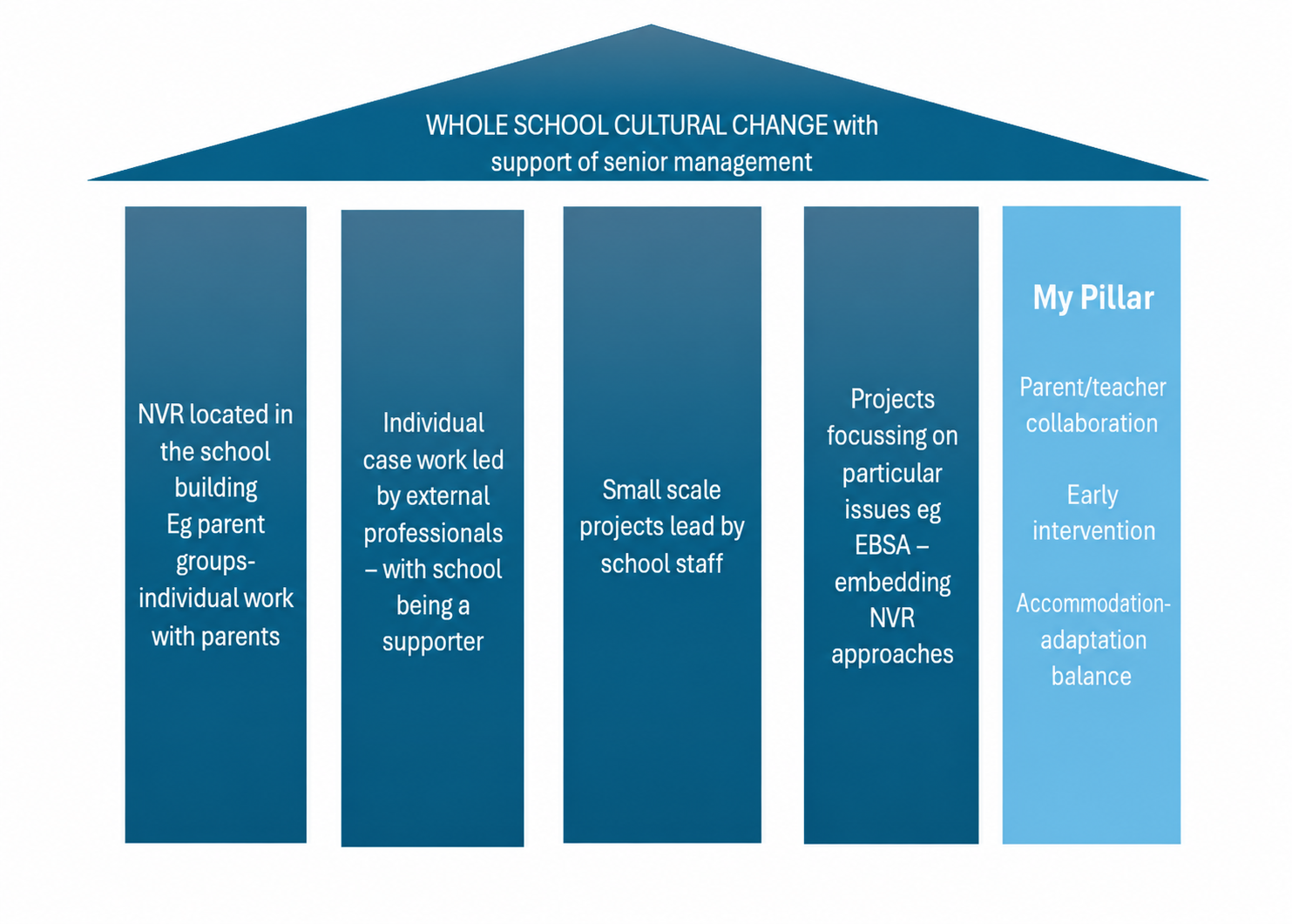
My Pillar of Interest
- As an educational psychologist who has spent many years working with schools, families and children, I’ve been particularly interested in early intervention work, including how to help parents and teachers confidently embed NVR principles before crises arise.
- There is currently a significant increase in referrals for anxious and avoidant patterns in children, usually within a neurodiverse presentation.
- Family and school systemic patterns around anxiety can start to emerge, often before major concerns have been identified, and before dysregulated shame (Weinblatt) becomes a significant issue.
- One of the nuanced challenges that parents and teachers are grappling with is how to balance healthy adaptations (to remove barriers) without sliding into over-accommodation * or reduced teacher/ parental presence. (* accommodation: any actions adults may be doing, or even deliberately not doing, because of the child’s anxiety )
- Teachers and parents are surrounded by advice and different narratives, which can reduce their confidence and sense of their own legitimacy in knowing how best to go forward. This can also lead to different positioning between families and schools, which can cause disconnection.
Can NVR be a useful tool to explore the healthy adaptation versus overaccommodation conundrum?
 My position is that this is an Art, not a Science; there is no one-size-fits-all answer, and each family and school will benefit from opportunities to jointly explore these issues.
Action Research
An illustration of how I explored my ‘Pillar of Interest’ is a small-scale piece of action research involving one teacher and one family. Within this blog, I can not do full justice to the nuanced work that took place, though I hope this narrative gives at least a taste of the work.
Aim: To see the impact of a collaborative NVR approach on supporting teacher/parent confidence in managing child anxiety/avoidance.
Key elements of the project:
- Took place in a London primary school
- Key child – a junior school-aged child, presenting as “too good” in school, and showing some avoidance at home, i.e., at a stage when there is limited concern, but systemic patterns are developing (in addition, there is an older sibling with a diagnosis of ASD in the household)
- The work took place with parents and teacher as a collaborative partnership.
- The aim was to help parents and teachers understand their role in the anxiety cycle and, by changing their approach, help the child’s relationship with their own anxiety – to begin to manage better even without the parent/adult being present
Collaborative Partnership
- Joint teacher and parents workshop. Introducing them to specific elements of NVR and SPACE (Supportive Parenting for Anxious Childhood Emotions, Dr Eli Liebowitz) and helping them understand the interpersonal aspects of anxiety in children
- A particular focus on using supportive statements
- Noticing accommodations that teachers and parents made
- Thinking about which accommodations to reduce
- Using an announcement when there was to be a change in the accommodation made
- The teacher and parents agreed on the focus of the intervention – which aspects the teacher would intervene in, and what the parents would do at home
Actions:
- The parents and teacher discussed their observations and views, which helped them both “tweak” their input
- The family and the teacher started using supportive statements
- The teacher started to reduce some accommodations. For example, previously she would always choose the child if he put his hand up, in part because she was concerned he would feel upset if not chosen; this would be followed by giving him a supportive statement later
- The family wrote an announcement (with teacher input), saying their focus was on increasing some change (being brave), so the child would feel better able to tolerate their feelings. In the letter, the child was told they, as a family, would try a new thing each week (eg going somewhere new, sitting somewhere different at the table, having a different coloured toothbrush, etc)
Reflections of the Project
The teacher and parent both reflected that they found this a helpful project to be engaged with. Some examples of their comments in our reflective feedback conversation were:
Teacher comment
 “I think, for me, it’s really opened up my eyes to seeing things in a different way, particularly with the accommodation. So many things, I was doing without actually realising that I was doing; I’ve become more conscious about the decisions I make with all children. Noticing me doing… is actually not helping him, because it’s not helping him manage that feeling of being uncomfortable, which at times he will be”
Parental Comments
“I’ve just found myself saying, it’s gonna be fine, in an entirely level tone of voice, so much more, while we’ve been working together than I did before . . .
I think it’s made me think how much we participate in the escalation of feeling. Some of what we’ve been trying to do is almost that refusal to engage, not in terms of what they’re saying, but with the emotion they’re bringing”
“I think that’s my biggest thing I’m taking from it, is actually noticing my practice, and noticing their responses. To see how that kind of maps out, and whether I could do something differently …”
My reflections
- Working as a collaborative partnership, with joint training, promoted safety and is good for exploring the accommodation/adaptation dilemma – it is also a good model to reduce teacher/ parent blaming.
- Such rich discussions and thoughts, and in directions that were unexpected, meant we were all able to learn together from each other
- It is possible to see change in short time frames. The teacher and parents reported that they were developing their confidence in when and how to use the applied NVR ideas, and had observed some subtle shifts in how the child seemed to be reacting in situations.
- Ripple effects: The teacher reported on how she would generalise her knowledge in other situations and with other pupils.
- The parents reported they would continue with the approach and use it with their other child.
- This gives a protocol for using this model with a bigger group of parents and teachers to see if it can be impactful on a larger scale
My final thoughts
- It was a real privilege working alongside the parents and teacher and observing how brave they were stepping out of a more traditional teacher/parent dynamic. Their conversations were so rich, and this inspired me to think about how valuable it is to address issues of adaptation and accommodation.
- Are we missing opportunities in primary school? It seems that applying NVR has a role in early intervention work. Further school-based research would be very exciting and important to ensure its efficacy.
- My sense is that the ripple effect of small-scale work in schools shouldn’t be underestimated, and that practitioners shouldn’t be discouraged if they can not work within the entire school system.
“We may not finish the work, yet it is ours to begin”.
Written by Lisa Barry
Educational Psychologist, PartnershipProjects Associate, and NVR Association (NVRA) Accredited Practitioner
Accreditation Module Participant, 2025
Enjoyed this? You can find out more about NVR in Schools here >